




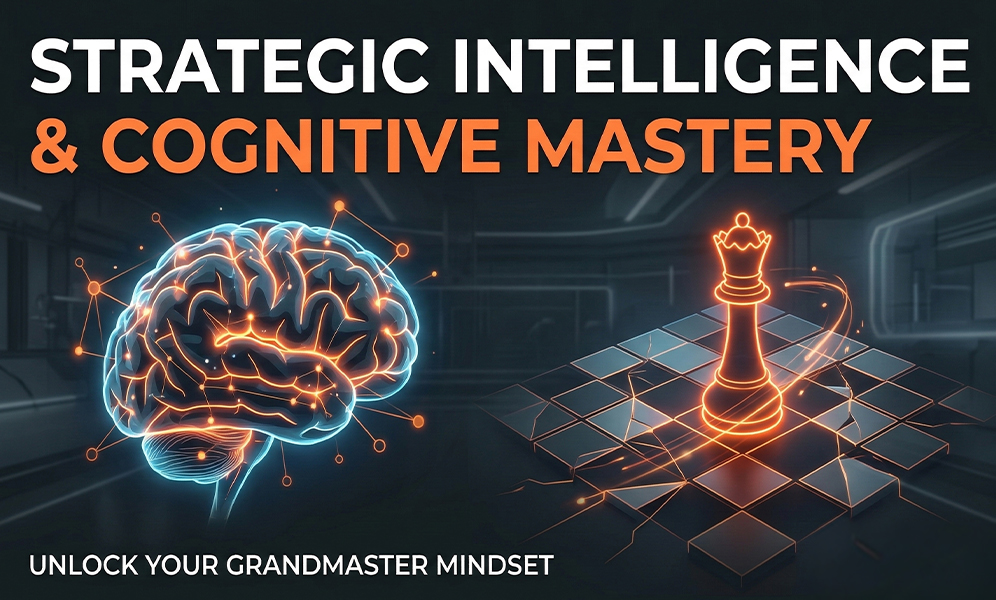
01. The Historical Genesis
The story of chess begins in 6th-century India with Chaturanga. This early version mirrored the four divisions of the Indian military: infantry, cavalry, elephants, and chariotry. As the game traveled through the Silk Road to Persia, it evolved into Shatranj, where the term "Shah Mat" (The King is dead) originated.
By the 15th century, European modifications introduced the modern rules we recognize today, most notably the transformation of the "Vizier" into the omnipotent "Queen," shifting the game's pace from a slow crawl to a dynamic battle of rapid calculation.
02. Cognitive Architecture
Chess is more than a board game; it is a cognitive simulator that rewires the neural pathways of the brain.
Divergent Thinking
The ability to generate multiple solutions to a single problem. Chess players calculate hundreds of variations before deciding on a single move.
Pattern Recognition
Expert players don't just "think"; they recognize structures. This facilitates rapid decision-making in high-pressure environments.
03. The Mathematics of Infinity
The complexity of chess is mathematically quantified by Shannon's Number ($10^{120}$). To put this in perspective, there are only $10^{80}$ atoms in the observable universe. This means every game of chess is a unique journey through a mathematical space so vast it can never be fully mapped.